COOK ISLANDS WEATHER
Best time to visit, latest forecasts from Rarotonga and Aitutaki, sunshine hours, seasons, cyclone risk, weather for kite surfing and more
When is the best time to visit the Cook Islands?
I'm tempted to say anytime...but here's a quick overview.
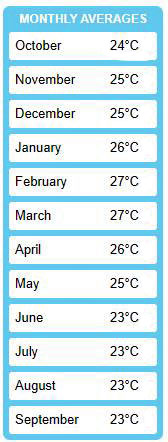
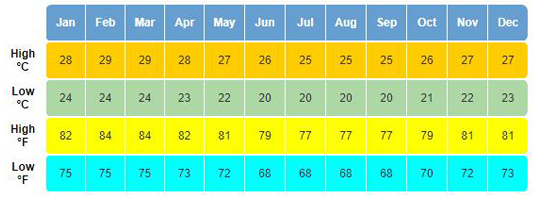
You can expect the longest sunny days from October to March, but it can get a bit humid too as heavy showers are common particularly in the afternoon. It's also the cyclone season, so there's a small risk of more dramatic weather. June, July and August are cooler months but temperatures are typically still in the mid 20s celcius (upper 70s F) but it can feel chilly at night (but never cold). Aitutaki is 3 or 4 degrees celcius warmer than Rarotonga each month but has similar weather patterns. The further north you go, the hotter it gets. Average sea temperatures around Rarotonga range from 25C, 77F (Jun-Aug) to 28C, 82F (Jan- Feb). All I can suggest is you read the more detailed information below and decide for yourself
IN SHORT
Cook Islands weather is typically tropical to sub-tropical with just two seasons...dry and wet. There's actually not much difference between the two. In the Northern Cooks Islands, temperatures are fairly constant throughout the year, while in the Southern Cooks (that inlcudes Rarotonga and Aitutaki) there is a difference of around 4°C between the warmer and cooler months. Mangaia in the south is the coolest island; Penrhyn and Rakahanga in the North are the hottest as they're closer to the equator (typically 5-7 degrees celcius warmer than Rarotonga)
RAROTONGA
WET SEASON: NOVEMBER TO APRIL/MAY
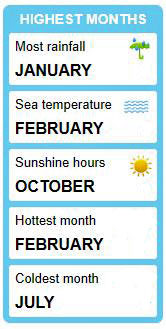
The wet season begins in late November and lasts until April or May, and sometimes longer in the Southern Cooks (that includes Rarotonga and Aitutaki). This is also the low season for tourism. November to March is the cyclone (hurricane) season too. It can become hot and humid (29 degrees celcius/84 fahrenheit by day) with bright sunny mornings and late afternoon downpours around Rarotonga. As the heat accumulates over the Pacific Ocean during this season, depressions can form bringing with them thunderstorms, strong winds and the occasional tropical cyclone. According to the national newspaper, Cook Islands News: "on Rarotonga we judge how hot the weather is by checking how much the tar seal on the roads has melted!"
DRY SEASON: JUNE TO OCTOBER
July is "midwinter" and the average daily temperature is 25 degrees celcius/77 fahrenheit. This drops to around 19 degrees celcius/66 fahrenheit at night. And on really cold nights, it can fall as low as 14 celcius/57 fahrenheit! The lowest winter temperature on record was in 1965 when the thermometer fell to just over 9 degrees C (48F)!!!

WATER SPORTS enthusiasts can get specialist reports about Aitutaki. Click the logo (this is not an ad)
CYCLONE SEASON
1 November to 30 April
2023-24 FORECAST: HIGH RISK
The tropical cyclone risk for the Cook Islands is high based on forecast climate conditions and analysis of historical records. There's potential for at least one cyclone to be severe, reaching category three or higher and a category five cyclone (the most severe) cannot be ruled out. There's also an increased risk of extreme winds, storm surge and flooding causing damage
Source: Cook Islands Meteorological Services
Check the latest Met office bulletin
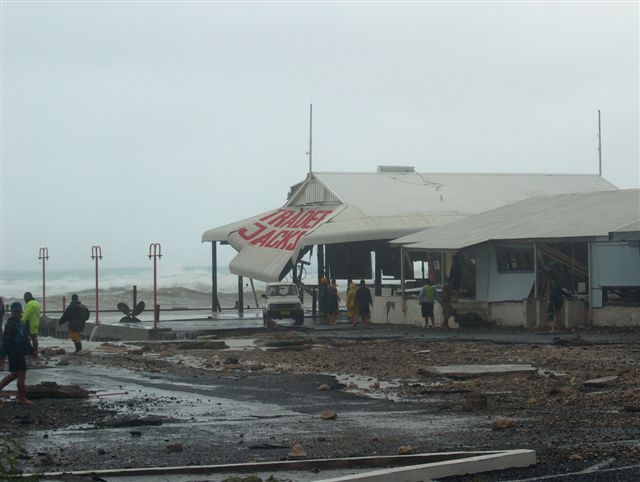
The after effects of one of 5 cyclones in 5 weeks in 2006. Such events are rare
Cyclones (elsewhere called hurricanes or typhoons) are a fact of life in this part of the world and are categorised as 1 to 5 where 5 is the most intense .
At worst cyclones can bring winds around 200kph (124mph), very stormy seas, flooding and extensive damage. But the extreme ones are relatively rare. A Canadian professor who studied their history says that between 1820 and 2006 they averaged less than one a season. And 29% per cent occur in February. The most recent serious one was Cyclone Pat which hit Aitutaki in 2010. And the worst cyclone season in living memory was in 2005 when there were five cyclones in five weeks, although the fifth degraded to a tropical storm when it reached the Islands. According to the Director of the local met office, the average is 1.1 a year